
Cormac McCarthy Books in Order: His Novels, the Border Trilogy, and Final Works
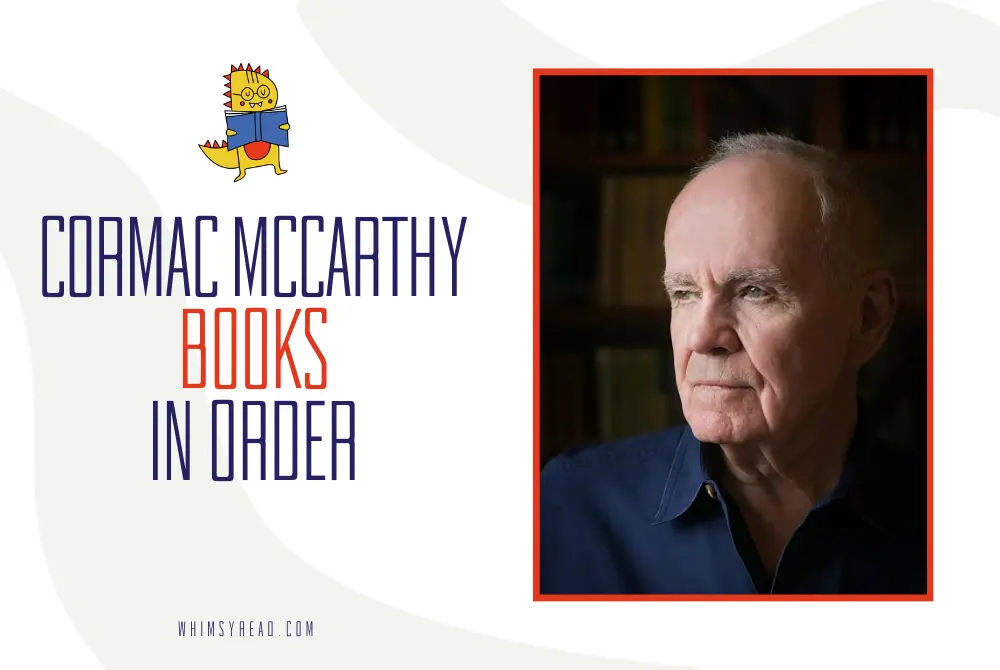
Cormac McCarthy was an American novelist known for stark prose, morally complex characters, and stories about violence, survival, human nature, and the American West. His writing ranges from Southern Gothic fiction set in Appalachia to sprawling Western epics and post-apocalyptic journeys.
Most of McCarthy’s novels stand alone, but two groups are connected: the Border Trilogy and the two-book sequence beginning with The Passenger. This guide lists all 12 novels in publication order, with summaries to help you decide where to start, followed by his other notable published works.
Cormac McCarthy Books in Publication Order
1. The Orchard Keeper (1965)
McCarthy’s debut novel takes place in rural Tennessee during the early twentieth century. Its story follows a young boy, a bootlegger, and an aging man whose lives intersect in a changing Appalachian landscape.
The novel establishes themes that recur throughout McCarthy’s career: isolation, the passage of time, the tension between civilization and nature, and the lives of people existing on society’s margins.
2. Outer Dark (1968)
Set in an isolated Appalachian world, Outer Dark follows Culla Holme and his sister, Rinthy, after a disturbing family secret sets their lives on separate paths. Their journeys unfold against a landscape populated by unsettling characters and persistent danger.
The novel is dark and often unsettling, combining Southern Gothic atmosphere with questions about guilt, fate, and moral responsibility.
3. Child of God (1973)
Lester Ballard is a violent and deeply isolated man who becomes increasingly disconnected from the community around him. After losing his home and place in society, he descends into disturbing behavior in the mountains of Tennessee.
This short, brutal novel examines alienation, social rejection, and the capacity for cruelty. It is among McCarthy’s most disturbing works and is not necessarily the best starting point for readers unfamiliar with his writing.
4. Suttree (1979)
Cornelius Suttree abandons a more conventional life to live along the Tennessee River in Knoxville, where he encounters drifters, criminals, and other people on society’s fringes. His experiences form a sprawling portrait of an eccentric community and a man trying to understand himself.
More expansive and frequently more humorous than McCarthy’s darker novels, Suttree explores loneliness, friendship, mortality, and the search for meaning. It is also one of his most linguistically rich and demanding books.
5. Blood Meridian; or, The Evening Redness in the West (1985)
Set in the American Southwest and Mexico during the mid-nineteenth century, Blood Meridian follows a teenage runaway known as the Kid who becomes involved with a violent group of scalp hunters. Their journey unfolds amid brutal frontier conflict, with the enigmatic Judge Holden emerging as one of the novel’s most memorable characters.
The book challenges romantic images of the American West through its relentless depiction of violence and its philosophical questions about war, power, and human nature. It is often regarded as one of McCarthy’s major literary achievements.
6. All the Pretty Horses (1992)
John Grady Cole, a young Texan whose familiar world is disappearing, travels into Mexico with his friend Lacey Rawlins. Their search for freedom and a different way of life leads them into work on a ranch, complicated romance, and dangerous encounters.
The novel combines a coming-of-age story with a Western adventure. It is the first book in the Border Trilogy and is often recommended as an accessible introduction to McCarthy’s fiction.
7. The Crossing (1994)
Set before and during the Second World War, The Crossing follows Billy Parham, a young rancher who travels from New Mexico into Mexico after encountering a wolf. His journey becomes an increasingly difficult exploration of responsibility, loss, and the relationship between humans and the natural world.
This second Border Trilogy novel is more meditative than its predecessor. Billy’s experiences lead him through a series of encounters and reflections on fate, suffering, and the limits of human understanding.
8. Cities of the Plain (1998)
The final novel in the Border Trilogy brings together John Grady Cole and Billy Parham, whose lives intersect while they work on a ranch near the United States-Mexico border. Their hopes for the future are complicated by changing circumstances and a relationship that places John Grady in a dangerous position.
The novel concludes the trilogy’s exploration of the fading American frontier, the passage into adulthood, and the cost of holding on to a disappearing way of life.
9. No Country for Old Men (2005)
When Llewelyn Moss discovers a drug deal gone wrong in the Texas desert, he takes a case of money and becomes the target of a relentless pursuit. Anton Chigurh, a terrifying and seemingly unstoppable killer, follows the trail while Sheriff Ed Tom Bell tries to understand the violence overtaking his jurisdiction.
This crime thriller combines a tense pursuit with a meditation on morality, chance, and changing times. It was adapted into the Academy Award-winning film of the same name.
10. The Road (2006)
In a devastated post-apocalyptic landscape, a father and his young son travel south in search of a safer place to live. They face hunger, cold, exhaustion, and the constant threat posed by other survivors.
The novel strips McCarthy’s prose down to an especially spare style, focusing on the emotional bond between father and child. It explores love, moral responsibility, and the struggle to preserve humanity in a world that seems to have lost it.
11. The Passenger (2022)
Bobby Western, a salvage diver haunted by personal loss, investigates a sunken aircraft and discovers that something important appears to be missing. The mystery draws him into a wider web of suspicion while he struggles with grief, guilt, and the legacy of his family.
Set largely around the American Gulf Coast, the novel blends suspense with reflections on science, mathematics, consciousness, and the limits of human knowledge. It is the first of McCarthy’s final two companion novels and should be read before Stella Maris.
12. Stella Maris (2022)
Alicia Western, Bobby’s sister, checks herself into a psychiatric facility in Wisconsin. Through conversations with her psychiatrist, she discusses mathematics, philosophy, hallucinations, grief, and the troubled relationship between her intellectual life and her emotional experience.
Unlike many conventional novels, Stella Maris consists almost entirely of dialogue. It expands the ideas and family history introduced in The Passenger, offering a more intimate and philosophical exploration of the Western siblings’ lives.
The Border Trilogy Books in Order
The Border Trilogy follows two young men whose experiences unfold around the United States-Mexico border. Although the first two books focus on different protagonists, the final novel brings their stories together.
Read the trilogy in this order:
- All the Pretty Horses (1992)
- The Crossing (1994)
- Cities of the Plain (1998)
The trilogy is best read in publication order. Each novel can be appreciated individually, but the final book has greater significance when you already know John Grady Cole and Billy Parham.
The Passenger Books in Order
McCarthy’s final two novels are closely related, following siblings Bobby and Alicia Western through different perspectives and narrative approaches.
- The Passenger (2022)
- Stella Maris (2022)
Read The Passenger first. Stella Maris provides important context for the siblings’ relationship and explores some of the philosophical and psychological questions raised in the first novel.
Cormac McCarthy’s Other Published Works
McCarthy also wrote plays, screenplays, and short fiction. These works are separate from his 12-novel bibliography, but they may interest readers who want to explore more of his writing.
The Gardener’s Son (1976)
This screenplay was written for a television film based on a nineteenth-century industrial dispute in South Carolina. It explores class divisions, family conflict, and violence in a historical setting.
The Stonemason (1994)
This play follows several generations of an African American family in Kentucky, focusing on work, family responsibility, faith, and the challenges of passing knowledge from one generation to the next.
The Sunset Limited (2006)
This two-character play centers on a conversation between two men whose radically different beliefs about life, death, and faith lead to a philosophical confrontation. Its dialogue-driven form makes it an interesting companion to Stella Maris.
The Counselor (2013)
Written as a screenplay, The Counselor follows a lawyer who becomes involved in a dangerous criminal transaction and discovers how quickly his choices can spiral beyond his control. It was adapted into a feature film directed by Ridley Scott.
The Kekulé Problem (2017)
This nonfiction essay explores the origins of human consciousness through the work of chemist August Kekulé and the question of how the unconscious mind contributes to thought. It offers a glimpse into McCarthy’s interest in science and cognition, subjects that also appear in his final novels.
McCarthy also published short fiction earlier in his career, including “Wake for Susan” and “A Drowning Incident.” These are not full-length novels and are not included in the 12-book list above.
Which Cormac McCarthy Book Should You Read First?
McCarthy’s writing can be challenging, so the best starting point depends on your interests and tolerance for dark material.
- For a relatively accessible introduction: All the Pretty Horses offers a coming-of-age story set against the backdrop of the American West.
- For crime and suspense: No Country for Old Men delivers a tightly focused pursuit involving a criminal discovery and a relentless killer.
- For post-apocalyptic fiction: The Road is a powerful, spare novel about a father and son trying to survive.
- For his most celebrated Western writing: Blood Meridian is an ambitious, exceptionally violent examination of the American frontier.
- For a philosophical, expansive novel: Suttree combines dark humor, rich language, and reflections on life at the margins.
- For his final literary period: Read The Passenger followed by Stella Maris.
If you want to understand the development of McCarthy’s style, read the 12 novels in publication order. If you are new to his work, beginning with All the Pretty Horses, No Country for Old Men, or The Road may be more approachable than starting with his earliest novels.
Frequently Asked Questions
How many novels did Cormac McCarthy write?
Cormac McCarthy published 12 novels between 1965 and 2022. His final two novels, The Passenger and Stella Maris, were released in 2022, shortly before his death in June 2023.
What was Cormac McCarthy’s first book?
His first novel was The Orchard Keeper, published in 1965. It is set in rural Tennessee and introduces themes of isolation, nature, and social change that recur throughout his fiction.
What was Cormac McCarthy’s last novel?
Stella Maris, published in December 2022, was his final novel. It is the companion to The Passenger, which appeared about six weeks earlier.
Do you have to read the Border Trilogy in order?
Reading the Border Trilogy in publication order is recommended. All the Pretty Horses introduces John Grady Cole, The Crossing follows Billy Parham, and Cities of the Plain brings the two characters together.
Is The Passenger a series?
The Passenger is the first of two companion novels, followed by Stella Maris. They are related through Bobby and Alicia Western and are best read in that order.
Which Cormac McCarthy book is the easiest to start with?
Many readers find All the Pretty Horses or No Country for Old Men more accessible than his earlier, more experimental novels. The Road is another strong option if you prefer a relatively short, emotionally focused story.
Is Blood Meridian based on a true story?
Blood Meridian draws on historical settings and frontier violence, including the activities of scalp-hunting groups in the nineteenth-century American Southwest and Mexico. However, it is a work of fiction, not a straightforward historical account.
Did Cormac McCarthy write plays and screenplays?
Yes. His other works include the play The Sunset Limited, the play The Stonemason, the screenplay The Gardener’s Son, and the screenplay The Counselor. He also wrote the nonfiction essay The Kekulé Problem.
Final Note
Cormac McCarthy’s bibliography moves from the isolated communities of Appalachia to the violence of the American frontier, the moral tensions of modern crime, and the bleak landscapes of a post-apocalyptic world. His final novels turn increasingly toward questions of consciousness, science, and grief.
For a first-time reader, All the Pretty Horses is a strong introduction. For a connected reading experience, follow the Border Trilogy in order and finish with The Passenger and Stella Maris.

Leave a Reply