
5 Best Books on Critical Thinking: My Honest Reviews From a Former Banker (2026 Updated)
Nine years in banking teaches you one thing above everything else: most bad decisions are not made because people lack information. They are made because people are not thinking clearly about the information they already have.
I watched it happen repeatedly. Smart, qualified people misreading market signals because the information confirmed what they already believed. Meetings where the loudest voice won regardless of the quality of the argument. Proposals approved not because the evidence was strong but because the presenter was confident. Critical thinking — the actual skill of evaluating evidence, spotting flawed reasoning, and updating your beliefs when the facts change — was the rarest and most valuable thing in the room.
When I moved from banking into SEO and content strategy, I expected things to be different. They were not. The same cognitive traps appear in different clothes: clients who mistake correlation for causation in their analytics data, content strategies built on what feels right rather than what the evidence supports, marketing claims that collapse under the slightest scrutiny.
These five books are the ones I return to when I need to sharpen the thinking behind the work. They cover different dimensions of the same fundamental skill — and together they give you a more complete toolkit than any single book can provide.
What Is Critical Thinking — And Why Most People Misunderstand It
Before the book reviews, a short clarification that will make everything below more useful.
Critical thinking is not scepticism for its own sake. It is not about doubting everything or never trusting anyone. It is a specific set of cognitive habits — questioning assumptions, demanding evidence, recognizing logical fallacies, distinguishing between correlation and causation, and being willing to change your mind when the evidence changes.
The reason most people struggle with critical thinking is not that they are not intelligent. It is that human brains were not designed for it. Our cognitive architecture evolved for speed and pattern recognition — for making fast decisions with incomplete information in environments where hesitation had costs. The mental shortcuts that kept our ancestors alive (fear-based threat assessment, tribal in-group thinking, reliance on authority) are the same shortcuts that make us vulnerable to misinformation, manipulation, and self-deception in modern life.
Critical thinking is the deliberate override of those shortcuts. It is not natural — it is a skill, and like any skill it requires deliberate practice and the right tools. These five books provide those tools.
The 5 Best Books on Critical Thinking
1. Factfulness: Ten Reasons We’re Wrong About the World — Hans Rosling, Anna Rosling Rönnlund & Ola Rosling
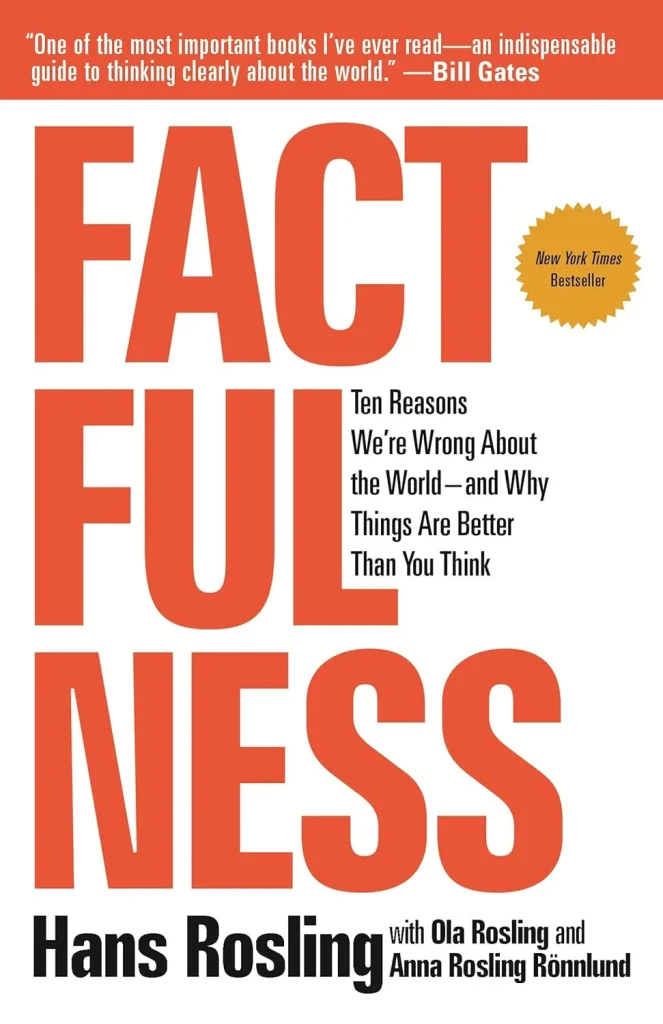
Best for: Dismantling unconscious bias with data and replacing fear with facts
Published: April 3, 2018
Hans Rosling was a Swedish physician and global health professor who spent his career trying to get people to understand the world as it actually is rather than as their instincts and media consumption told them it was. Factfulness is his final book — completed while he was dying of pancreatic cancer — and it is an extraordinary piece of work.
The book opens with a quiz. Thirteen questions about global trends — child mortality, extreme poverty, girls’ education, climate change, vaccination rates. Most readers score worse than random chance. Not because they are uninformed, but because the information they have absorbed from news, education, and cultural narratives reflects the world as it was decades ago rather than as it is today. The world has changed dramatically. Our mental models of it have not.
Rosling identifies ten specific “instincts” — hardwired cognitive tendencies that systematically distort our perception of reality. The Gap Instinct makes us see a divided world of rich and poor when the reality is a vast middle. The Negativity Instinct makes bad news feel more true than good news because media economics rewards alarm. The Fear Instinct makes us assess risk by emotional response rather than statistical probability. The Destiny Instinct makes us assume that cultures, countries, and individuals are fixed when they are constantly changing.
What you will learn: A practical framework for fact-checking your own assumptions about the state of the world, a methodology for consuming data and news media with genuine scepticism rather than reactive belief, and specific tools for each of the ten instincts — how to recognize when each one is distorting your judgment and what to do instead.
From my experience: The Straight Line Instinct is the one I encounter most in content and SEO work — the assumption that a trend currently moving in one direction will continue in that direction indefinitely. Client conversations about traffic curves, keyword trends, and algorithm changes are full of this fallacy. Rosling’s framework gives me language to name it clearly.
Why this book specifically: Factfulness is not just about knowing more facts. It is about having a better relationship with the uncertainty that underlies all factual claims — understanding that most things exist on a spectrum and that strong emotions about data are usually a warning sign that System 1 has taken over.
Who this is for: Anyone who consumes news and wants to do so with genuine critical distance. Also essential for anyone working with data in a professional context — analysts, strategists, marketers, managers, researchers.
2. Slouching Towards Bethlehem — Joan Didion

Best for: Learning intellectual honesty and observational clarity through literary journalism
Published: 1968 (Reissue: October 28, 2008)
This is the most unexpected book on this list. Joan Didion’s landmark essay collection has nothing obvious to do with critical thinking as it is usually defined — there are no frameworks, no cognitive bias taxonomies, no data literacy tools. What it has instead is something rarer and in its own way more valuable: a demonstration, through the quality of the prose itself, of what genuinely clear thinking looks like in practice.
Didion was one of the finest journalists and essayists of the twentieth century. In the essays collected here — most written for magazines in the 1960s — she reports on the San Francisco counterculture, Hollywood, Las Vegas, and American cultural life with a precision and emotional detachment that is almost disorienting. She does not tell you what to think about what she observes. She observes with such rigour and honesty that the thinking follows naturally.
The critical thinking lesson in Didion is subtle but important: intellectual honesty requires the willingness to describe what is actually there rather than what you expected or wanted to find. It requires the resistance of the narrative pull — the human tendency to shape observations into a story that confirms existing beliefs. Her journalism does this with exceptional discipline.
What you will learn: Not a framework but a standard — what it looks like to observe without the filter of ideology, to report without the distortion of conclusion-first thinking, and to write about complex social phenomena without reducing them to morality plays. For readers who work with information professionally, Didion’s essays are a masterclass in the discipline that precedes analysis.
The essay that matters most: Slouching Towards Bethlehem itself — the title essay about the Haight-Ashbury district in 1967 — is the clearest example of her method. She reports what she sees with forensic accuracy, allows the contradictions to stand without resolution, and produces a portrait of idealism and its failures that is more true than any polemical account could be.
From my experience: The single most common critical thinking failure I encounter professionally is conclusion-first analysis — starting with what you want to prove and selecting evidence accordingly. Didion’s method of rigorous observation before interpretation is the antidote to that pattern. Reading her regularly is the closest thing I have found to inoculation against it.
Who this is for: Readers who want to develop observational discipline and intellectual honesty as writing and thinking skills. Also essential for journalists, content creators, researchers, and anyone whose work involves making sense of complex human phenomena.
3. The Demon-Haunted World: Science as a Candle in the Dark — Carl Sagan with Ann Druyan
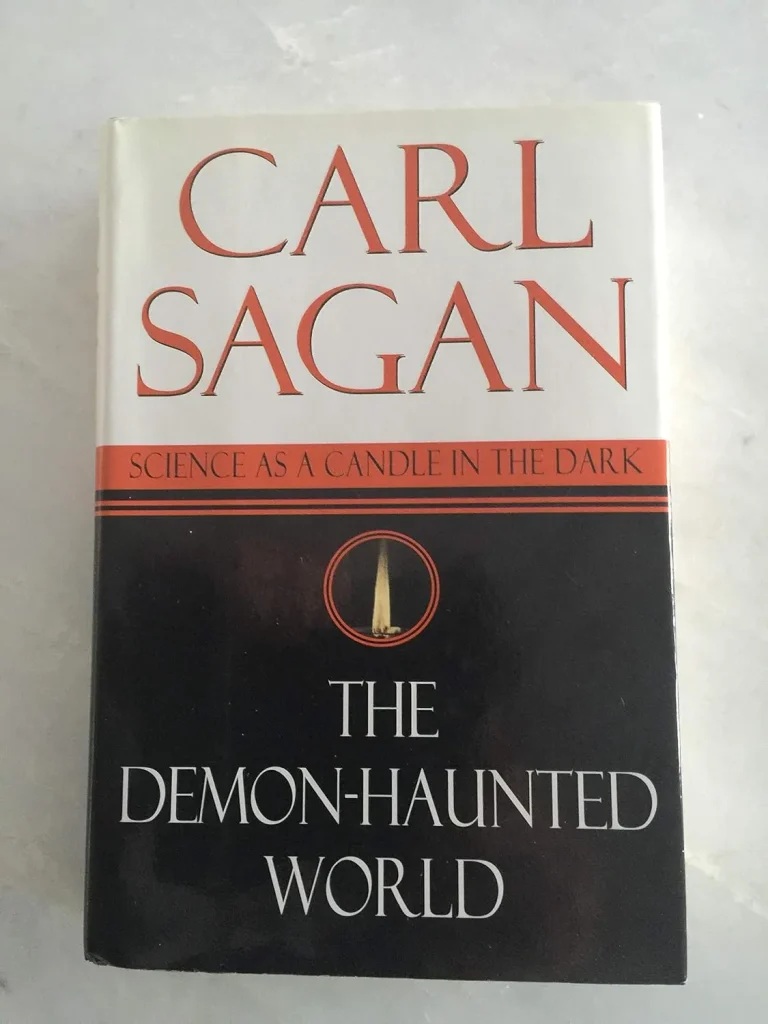
Best for: Building a rigorous framework for distinguishing good reasoning from bad
Published: February 25, 1997
This book was published in 1997 and it has never been more relevant than it is in 2026. Carl Sagan — one of the most celebrated science communicators of the twentieth century — wrote it as a defence of rational thinking in a culture he saw becoming increasingly susceptible to superstition, pseudoscience, and the manipulation of credulous belief.
The central gift of this book is what Sagan calls the “Baloney Detection Kit” — a set of tools for evaluating claims with genuine rigor. Seek independent confirmation of facts. Encourage substantive debate rather than argument from authority. Question your own arguments at least as hard as those of your opponents. Check whether a hypothesis is falsifiable. Ask whether the simpler explanation is being overlooked in favour of the more dramatic one. These are not advanced concepts — they are the basic protocols of honest thinking, and they are violated constantly in public discourse.
Sagan is careful not to argue for cynicism. He is not telling you to distrust everything. He is arguing for a specific kind of calibrated confidence — the willingness to hold beliefs proportionally to the evidence for them, to update when evidence changes, and to distinguish between what you know and what you merely believe.
What you will learn: The history of pseudoscience and how it exploits the same cognitive vulnerabilities as genuine discovery, the specific logical tools that distinguish scientific reasoning from motivated reasoning, a framework for evaluating extraordinary claims — the principle that extraordinary claims require extraordinary evidence — and why a society’s ability to think critically is directly connected to its ability to govern itself well.
From my experience: The chapter on the difference between scepticism and cynicism changed how I approach client work. Healthy scepticism says “show me the evidence.” Cynicism says “nothing can be trusted.” Only one of those positions allows you to learn. In SEO and content strategy, distinguishing between genuine data and correlation dressed up as causation is a daily exercise in exactly the kind of thinking Sagan is describing.
Why it still matters in 2026: Every specific form of irrational belief Sagan describes — alien abduction, faith healing, conspiracy theory, the distrust of institutional expertise — has metastasised dramatically since 1997 with the amplification of social media. The tools he provides are more needed now than when he wrote the book.
Who this is for: Anyone who wants a rigorous intellectual framework for evaluating claims in any domain — science, politics, business, media. Also essential reading for parents who want to teach their children how to think rather than what to think.
4. Thinking, Fast and Slow — Daniel Kahneman
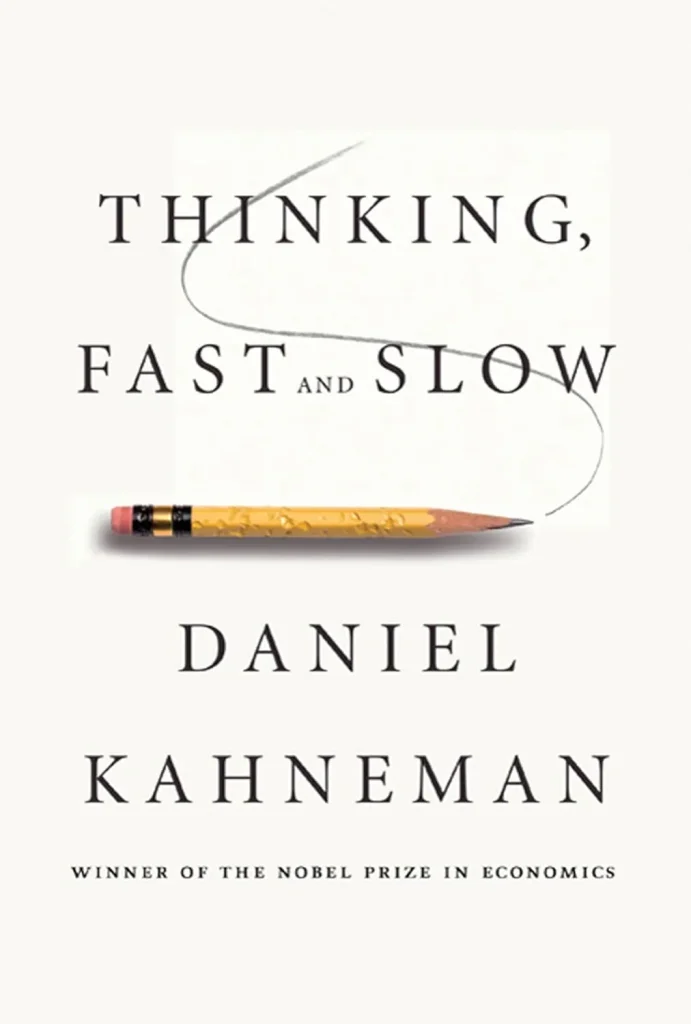
Best for: Understanding the two systems that drive every decision you make
Published: 2011 (Paperback: April 2, 2013)
This is the book I recommend first and most often — not because it is the most entertaining on this list but because it is the most foundational. Everything else you read about critical thinking makes more sense after you have read Kahneman.
Daniel Kahneman is a Nobel Prize-winning psychologist who spent decades studying how human judgment works — and how spectacularly it fails. His central framework distinguishes between two modes of thinking he calls System 1 and System 2.
System 1 is fast, automatic, emotional, and largely unconscious. It is the system that instantly recognizes a face, flinches at a loud noise, reads a sentence without conscious effort, and forms an impression of a person within seconds of meeting them. It is extraordinarily useful and operates almost entirely outside our awareness.
System 2 is slow, deliberate, effortful, and logical. It is the system you engage when you work through a mathematical problem, evaluate a complex argument, or consciously check whether your initial reaction to something is actually justified. It is more accurate than System 1 — but it is also exhausting, and we use it far less than we think we do.
The insight that makes this book transformative is the demonstration of how thoroughly System 1 dominates our decisions while System 2 convinces us that it was in charge. We make gut decisions and then construct logical justifications for them. We are systematically overconfident in our own judgment. We are predictably influenced by framing, priming, and anchoring in ways we cannot detect in the moment.
What you will learn: The full taxonomy of cognitive biases — availability heuristic, anchoring, the halo effect, loss aversion, the planning fallacy, overconfidence, and dozens more — explained through decades of psychological research and beautifully constructed experiments. Each chapter builds a more complete picture of how and when human judgment fails, and what to do about it.
From my experience: In banking, the anchoring bias was everywhere. The first number someone put on the table in a negotiation structured the entire conversation that followed, regardless of whether it bore any relationship to reality. Reading Kahneman retroactively explained dozens of outcomes I had witnessed without understanding. More importantly, it gave me a framework for spotting the same pattern in real time.
Who this is for: Everyone. This is the critical thinking book with the broadest application across professional and personal life. If you read only one book from this list, read this one.
5. Calling Bullshit: The Art of Skepticism in a Data-Driven World — Carl T. Bergstrom & Jevin D. West
Best for: Practical tools for detecting data manipulation and statistical deception
Published: August 4, 2020
This is the most contemporary book on this list and in some ways the most immediately applicable to daily life in 2026. Carl Bergstrom is a professor of biology at the University of Washington; Jevin West is an associate professor at the same institution’s Information School. Together they created a university course called “Calling Bullshit” that became one of the most shared syllabi on the internet before being turned into this book.
The premise is specific and important: in a world where data is increasingly used to justify claims, the ability to evaluate data critically has become a fundamental literacy skill. Not statistical expertise — most of us are never going to run regression analyses — but the ability to ask the right questions when someone presents a chart, a study, or a percentage as evidence for a claim.
What you will learn: How to identify the most common forms of data manipulation — cherry-picking, misleading axes, inappropriate comparisons, confusing correlation with causation, survivorship bias, and the specific ways that machine learning and AI-generated analysis can be used to make weak conclusions look rigorous. The book walks through real examples drawn from scientific papers, news articles, political claims, and viral social media posts — showing exactly how the deception works and what questions to ask to expose it.
What makes it stand out: The tone. Bergstrom and West are funny. The book reads like a conversation between two people who have spent years being frustrated by nonsense and have developed both the tools to identify it and the language to explain it clearly. It never condescends and never bores.
From my experience: In digital marketing and SEO, misleading data presentation is endemic. Dashboards that show metrics going up while the underlying business metric goes down. Reports that highlight conversion rate while omitting traffic volume. Case studies that present correlation as proof. This book gave me a cleaner vocabulary for challenging those presentations without sounding contrarian.
The specific chapter worth highlighting: The section on “Big Data” and artificial intelligence is the most useful for 2026 readers — it explains with unusual clarity how algorithmic outputs can be presented as objective truth when they are in fact encoding the assumptions and biases of their creators.
Who this is for: Anyone who regularly encounters data as evidence for claims — which in 2026 is essentially everyone. Particularly valuable for professionals in analytics, marketing, journalism, policy, research, or anyone who needs to evaluate quantitative claims as part of their work.
How to Choose the Right Book for Where You Are
Not everyone needs all five at once. Here is a practical guide based on what you are trying to develop:
If you want to understand how your own mind works: Start with Thinking, Fast and Slow. It is the most foundational book on this list and the one that makes everything else make more sense.
If you want to think more clearly about news and world events: Start with Factfulness. The ten instincts framework is immediately applicable to everything you read and watch.
If you want a rigorous framework for evaluating any claim: Start with The Demon-Haunted World. The Baloney Detection Kit is the most transferable intellectual tool on this list.
If you work with data professionally: Start with Calling Bullshit. The specific tools for identifying data manipulation are directly applicable to every chart, study, or percentage you encounter.
If you want to develop intellectual discipline as a practice: Start with Slouching Towards Bethlehem. Didion’s method of observation before conclusion is the hardest skill to develop and the most valuable to have.
The Five Core Principles of Critical Thinking
These principles run through all five books in different ways. Keep them in mind as you read:
Distinguish correlation from causation. Two things happening simultaneously does not mean one caused the other. This is the most common reasoning error in everyday life — and in data analysis.
Demand proportional evidence. The strength of a claim should be matched by the strength of the evidence offered for it. Extraordinary claims require extraordinary evidence. Kahneman, Sagan, and Bergstrom all make this point in different ways.
Recognize motivated reasoning. We are all more likely to accept evidence that confirms what we already believe and scrutinize evidence that challenges it. Knowing this about yourself is the first step toward correcting it.
Practice intellectual humility. Being willing to update your beliefs when evidence changes is not weakness — it is the defining characteristic of genuine rationality. The person who never changes their mind is not principled; they are not thinking.
Question the frame. How a question is asked, how data is presented, which comparisons are made — these framings shape conclusions before evidence is even evaluated. Identifying the frame is often more important than evaluating the content within it.
Frequently Asked Questions
What is the best book on critical thinking for beginners?
Thinking, Fast and Slow by Daniel Kahneman is the most accessible starting point — it explains the cognitive foundations of how we think and where we go wrong, in language that requires no prior knowledge of psychology or philosophy. Factfulness is the second best entry point, particularly for readers who want something more data-focused and immediately applicable to current events.
What is critical thinking and why does it matter?
Critical thinking is the disciplined practice of evaluating evidence, questioning assumptions, recognizing logical fallacies, and updating beliefs when evidence changes. It matters because the default cognitive shortcuts that humans rely on — speed, pattern recognition, emotional response — produce systematic errors in modern environments full of complex data, motivated information, and deliberate manipulation.
Is Thinking Fast and Slow still relevant in 2026?
Yes — more than ever. The cognitive biases Kahneman documents have not changed, and the information environments that exploit them have become dramatically more sophisticated. Some specific studies in the book have faced replication challenges, which Kahneman himself has acknowledged, but the core framework of System 1 and System 2 thinking remains the most useful lens available for understanding human judgment.
What is the difference between critical thinking and scepticism?
Critical thinking is a broad skill set encompassing evaluation of evidence, logical reasoning, and intellectual honesty. Scepticism is one component — the disposition to question claims before accepting them. Healthy scepticism is calibrated: it questions proportionally to the stakes and the quality of evidence available. Cynicism — the rejection of all claims regardless of evidence — is not critical thinking, it is a different kind of cognitive failure.
Is Calling Bullshit suitable for non-technical readers?
Yes. Bergstrom and West explicitly wrote the book for readers without statistical training. The tools they provide require no mathematical knowledge — they are conceptual and question-based rather than quantitative. If you can read a news article you can apply everything in this book.
What makes Joan Didion relevant to critical thinking?
Didion’s relevance is methodological rather than conceptual. Her journalism demonstrates what intellectual honesty looks like in practice — the discipline of observing without pre-formed conclusion, of allowing contradictions to stand without false resolution, of resisting the narrative pull toward simple stories about complex realities. These are critical thinking skills that cannot be taught through frameworks alone.
What should I read after these five books?
For deeper cognitive science: The Intelligence Trap by David Robson explains why intelligent people are often more vulnerable to certain cognitive errors. For logical reasoning specifically: Being Logical by D.Q. McInerny is a concise and rigorous introduction to formal logic. For media literacy: Trust Me, I’m Lying by Ryan Holiday is a bracingly honest account of how media narratives are manufactured, from someone who manufactured them professionally.
Final Verdict
Critical thinking is not a personality trait — it is a skill. Some people have more natural aptitude for it than others, but every person on this list developed their approach through deliberate practice, structured tools, and the intellectual discipline of checking their conclusions against the evidence rather than building evidence around their conclusions.
The five books above give you the tools to do the same. Kahneman explains the architecture of your own thinking. Rosling gives you a framework for evaluating the world’s data. Sagan provides the epistemological foundation for distinguishing good reasoning from bad. Bergstrom and West hand you the specific instruments for detecting data manipulation. Didion shows you what the disciplined practice of honest observation looks like at its finest.
Start with whichever entry point suits where you are. The thinking you develop from any of these books will compound across everything else you read — which is ultimately what the best books always do.

Leave a Reply