
5 Best Books About Ancient Rome: My Personal Reading Guide (2026 Updated)
Rome has never left me alone. That is the honest way to say it.
I came to ancient Rome through strategy — through the same analytical instinct that spent nine years in banking watching institutions succeed and fail, watching systems that looked permanent suddenly reveal the cracks that had been there all along. When I started reading Roman history seriously, I kept having the same unsettling experience: I had seen this before. The senator who prioritizes personal survival over institutional health. The general whose military genius is accompanied by an inability to navigate peacetime politics. The bureaucracy that keeps its paperwork running perfectly while the empire it serves disintegrates around it.
Rome is not ancient. It is a mirror. And the books on this list are the ones that showed me that most clearly.
I should be honest about my lens: I am a strategist and content creator with a background in finance, not a classical historian. What draws me to Roman history is not academic completeness but the quality of the thinking on offer — the way the best writers about Rome use the past to illuminate patterns that repeat. The five books below are the ones that do that most effectively, whether they are doing it through fiction, through scholarly analysis, or through the words of the Romans themselves.
Understanding the Three Eras — A Map Before the Books
Before diving into the reviews, a brief orientation makes everything easier to follow. Roman history spans roughly a thousand years and three dramatically different phases. Each book on this list is anchored in a specific era — knowing which era you are entering helps you read the books in the right sequence.
| Era | Approximate Dates | What It Was | Books on This List |
| The Republic | 509 BC — 27 BC | Senatorial governance, military expansion, the rise of individual strongmen | The First Man in Rome, The Histories (transition) |
| The Early Empire | 27 BC — AD 284 | The Caesars, the Pax Romana, dynastic intrigue, absolute power | I, Claudius, The Histories |
| The Decline and Fall | AD 284 — AD 476 | Military anarchy, fragmentation, the rise of Christianity, barbarian kingdoms | How Rome Fell, Barbarian Migrations |
Reading in this order — Republic, Early Empire, Decline — gives you the full arc. But each book also works independently. Start wherever your curiosity pulls you.
The 5 Best Books About Ancient Rome
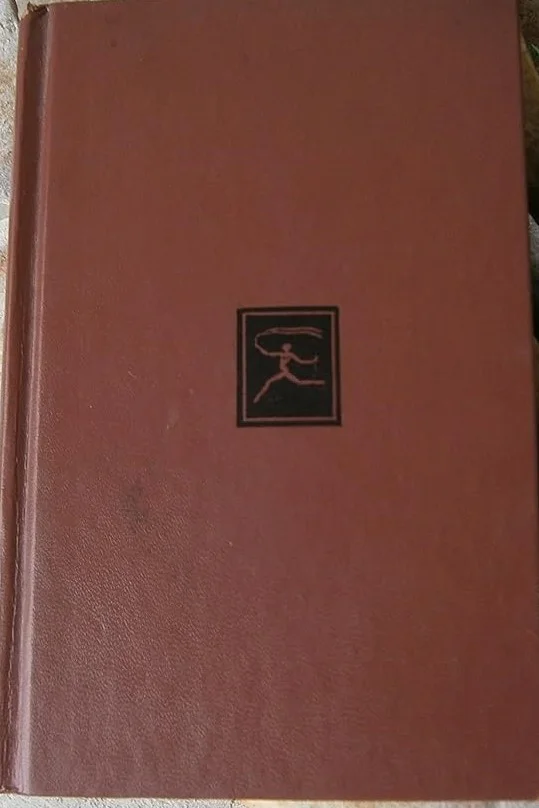
1. I, Claudius — Robert Graves
Best for: The most immersive, entertaining, and humanizing introduction to imperial Rome available
Published: 1934 (Modern Classics Edition: August 29, 2006)
This is the book I recommend first and most enthusiastically — not because it is the most historically rigorous on the list, but because it does something none of the others do: it makes you care about the people. Deeply, uncomfortably, sometimes hilariously care.
Robert Graves imagines the novel as the secret autobiography of Tiberius Claudius Drusus Nero Germanicus — the Emperor Claudius, generally dismissed by his contemporaries as a stammering fool, unfit for power, a figure of contempt in a family full of murderers and monsters. Claudius plays the fool deliberately, and I, Claudius is his account of how that performance kept him alive through the reigns of Augustus, Tiberius, and the genuinely terrifying Caligula.
The brilliance of the conceit is that Claudius as narrator is simultaneously the least powerful person in every room and the most perceptive observer in every room. He watches everything with the detached clarity that only someone who has learned not to be seen as a threat can maintain. The result is a portrait of the early imperial court that is racy, comic, horrifying, and psychologically precise all at once.
What you will learn: How the Julio-Claudian dynasty actually operated — the marriage alliances, the poisonings, the manufactured accusations, the way Augustus and Livia shaped the succession through decades of patient manipulation. Graves based the novel on Suetonius and other ancient sources, and his interpretation of the historical evidence is consistently intelligent. Reading I, Claudius gives you a mental map of the early empire that no straightforward historical account quite replicates.
The character that stays with you: Livia — Augustus’s wife and Claudius’s grandmother — is one of the great villains of historical fiction. Graves portrays her as the hidden architect of the dynasty, moving pieces across decades with a patience and ruthlessness that makes Machiavelli look impatient. Whether the historical Livia was actually like this is debated by scholars. As a portrait of how power operates through patience rather than force, it is unforgettable.
From my experience: I read I, Claudius during a particularly turbulent period at a previous company — an environment where organizational politics had reached a level of complexity that was genuinely exhausting. Reading Claudius navigate a world where every statement was potentially fatal and every relationship a potential weapon was both darkly funny and unexpectedly useful. The strategic patience Claudius demonstrates — saying less than you know, watching more than you reveal — is genuinely applicable outside ancient Rome.
A note on the companion volume: I, Claudius ends at the beginning of Claudius’s own reign. Graves wrote a sequel — Claudius the God — which covers his years as emperor. Both are worth reading in sequence.
Who this is for: Everyone — particularly readers who consider themselves non-fiction people and think historical fiction is not for them. I, Claudius will correct that assumption. Also essential for anyone who enjoyed the BBC television adaptation and wants more depth than a six-hour series can provide.
2. The First Man in Rome — Colleen McCullough
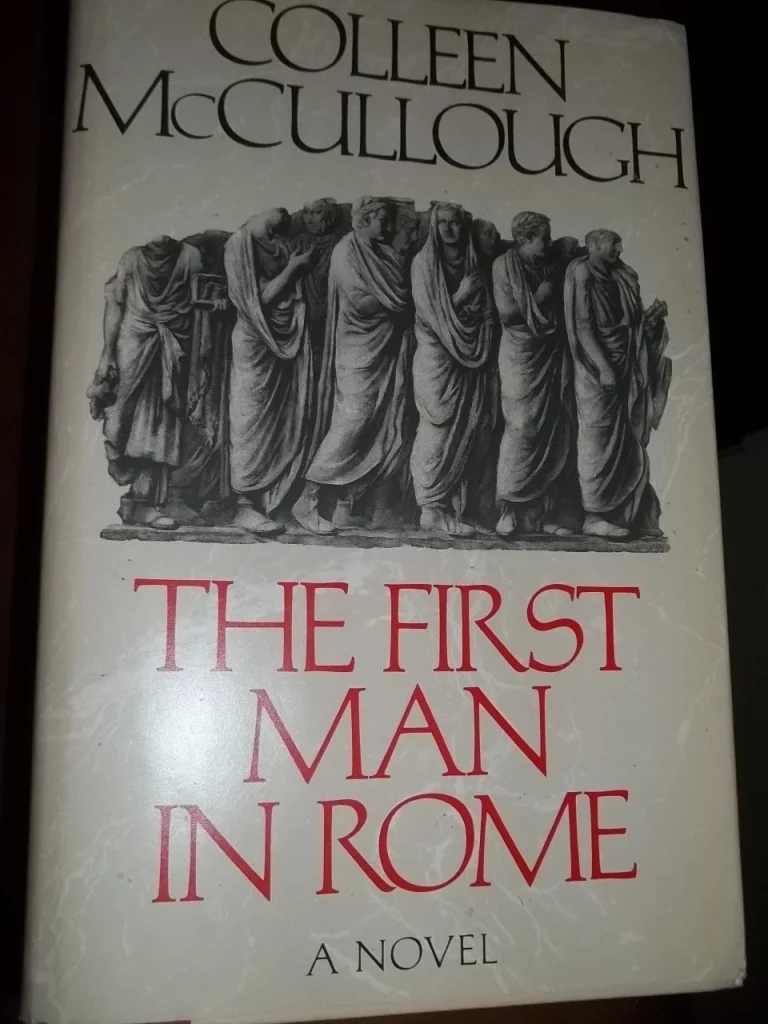
Best for: The late Republic at full dramatic intensity — the era that produced Caesar
Published: 1990 (Illustrated Edition: November 11, 2008)
If I, Claudius covers the Empire, The First Man in Rome covers the Republic — specifically the late Republic, the period when the institutions that had governed Rome for four centuries began visibly straining under the weight of an empire they were never designed to manage.
Colleen McCullough spent a decade researching this novel and the series it begins — the Masters of Rome sequence, which eventually runs to seven volumes covering the period from 110 BC through the assassination of Julius Caesar. The First Man in Rome is the first of those seven and covers the rise of Gaius Marius, a military genius from an undistinguished family who transformed the Roman army and became consul seven times — a record unprecedented in Roman history — and his complex alliance with the aristocratic, brilliant, and genuinely dangerous Lucius Cornelius Sulla.
The drama here is extraordinary because the historical material is extraordinary. Marius and Sulla are not fictional creations — they are real historical figures whose conflict would eventually produce the conditions that made Caesar possible. McCullough brings them to life with the specificity that comes from serious historical research combined with genuine narrative talent.
What you will learn: How the Roman Republic actually functioned — the Senate, the electoral system, the military structure, the class tensions between patricians and plebeians — in detail that makes the political dramas comprehensible rather than confusing. The specific military reforms Marius introduced that transformed Rome’s legions from a citizen militia into a professional army — reforms that had enormous unintended consequences for the Republic’s political stability. And the human cost of ambition at the highest levels of Roman society.
What makes McCullough stand apart: The research. She includes a substantial glossary and explanatory notes that make the Roman world genuinely accessible without interrupting the narrative. Scholars have occasionally quibbled with specific interpretations, but the overall historical framework is sound and the narrative weight is real. This is what serious historical fiction looks like when a writer takes both the history and the fiction seriously.
A note on the series: The Masters of Rome sequence continues through The Grass Crown (Sulla’s story), Fortune’s Favorites (the young Caesar), Caesar’s Women, Caesar, The October Horse, and Antony and Cleopatra. Reading the full sequence is one of the great sustained historical fiction experiences available — but The First Man in Rome stands fully on its own.
From my experience: The sections on the Senate — the procedural maneuvering, the coalition-building, the way personal feuds and institutional interests tangled into outcomes no single actor fully controlled — reminded me strongly of organizational dynamics I had watched play out in corporate settings. The Romans did not invent institutional dysfunction, but they documented it with unusual honesty. McCullough captures that honesty in fictional form.
Who this is for: Readers who want the Republic era specifically — the world that produced Caesar, Cicero, and the conditions that made the Empire necessary. Also excellent for readers who found I, Claudius compelling and want to understand the world that existed before the Julio-Claudians.
3. How Rome Fell: Death of a Superpower — Adrian Goldsworthy
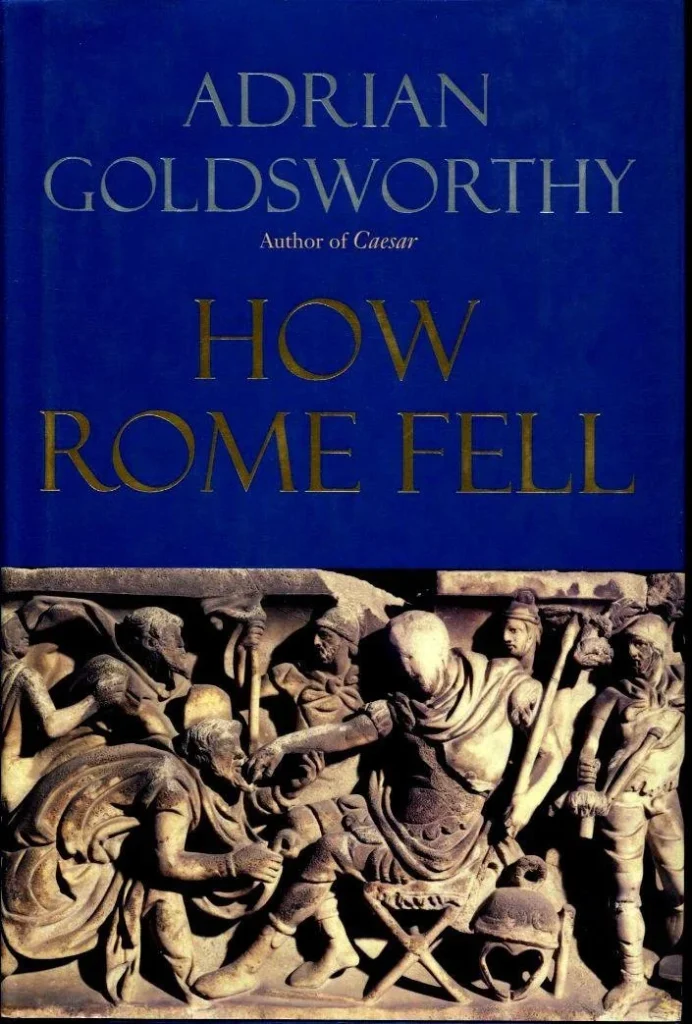
Best for: Understanding why Rome fell — the analytical case that internal rot mattered more than external enemies
Published: 2009 (Paperback: September 28, 2010)
Adrian Goldsworthy is one of the most readable military historians working today, and How Rome Fell is his most ambitious book — a sustained argument about why one of history’s most durable states eventually disintegrated, built from five centuries of detailed evidence.
His central argument challenges the conventional account. The conventional account of Rome’s fall focuses on external pressure — the Huns pushing Gothic tribes across the Danube frontier, the subsequent barbarian military pressure on a weakened empire, the eventual inability of the Western administration to defend its territory. Goldsworthy does not dismiss these factors. But he argues that they explain the timing and specific character of the fall rather than its underlying cause.
The underlying cause, in his account, was internal: a century-long process in which Roman institutions — military, administrative, political — gradually prioritized survival and short-term advantage over the longer-term interests they were designed to serve. Generals who kept armies intact as political insurance rather than deploying them against enemies. Emperors who avoided military campaigns because campaigns risked defeat and defeat risked assassination. A bureaucracy that continued functioning while the state it served hollowed out.
What you will learn: The political and military history of the third and fourth centuries in accessible detail — the Crisis of the Third Century, Diocletian’s reforms, Constantine’s transformation of the empire, the slow fragmentation of the Western administration. The specific mechanisms by which internal dysfunction compounded external pressure. And the human stories behind the analysis — Goldsworthy writes about historical figures as people making decisions under uncertainty, which produces history that reads as more honest than purely structural accounts.
The argument that stays with you: The observation that Rome did not fail suddenly. It failed gradually, across centuries, through a series of individually rational decisions made by people prioritizing personal and institutional survival that collectively undermined the broader system. This is not a unique historical pattern. It describes how most large, durable institutions eventually fail — and reading it against the background of current institutions is genuinely uncomfortable in useful ways.
From my experience: This book articulated something I had observed in banking but not been able to name clearly — the way organizations under sustained pressure begin optimizing for their own survival in ways that undermine the purpose they were created to serve. Goldsworthy’s Rome is a study of institutional decay that is specific, historical, and immediately recognizable.
Who this is for: Readers who want analytical history rather than narrative history — who want to understand the mechanisms behind the events rather than just the events themselves. Also essential for anyone interested in comparative political history or the dynamics of institutional decline.
4. The Histories — Tacitus (Translated by W.H. Fyfe, Revised by D.S. Levene)
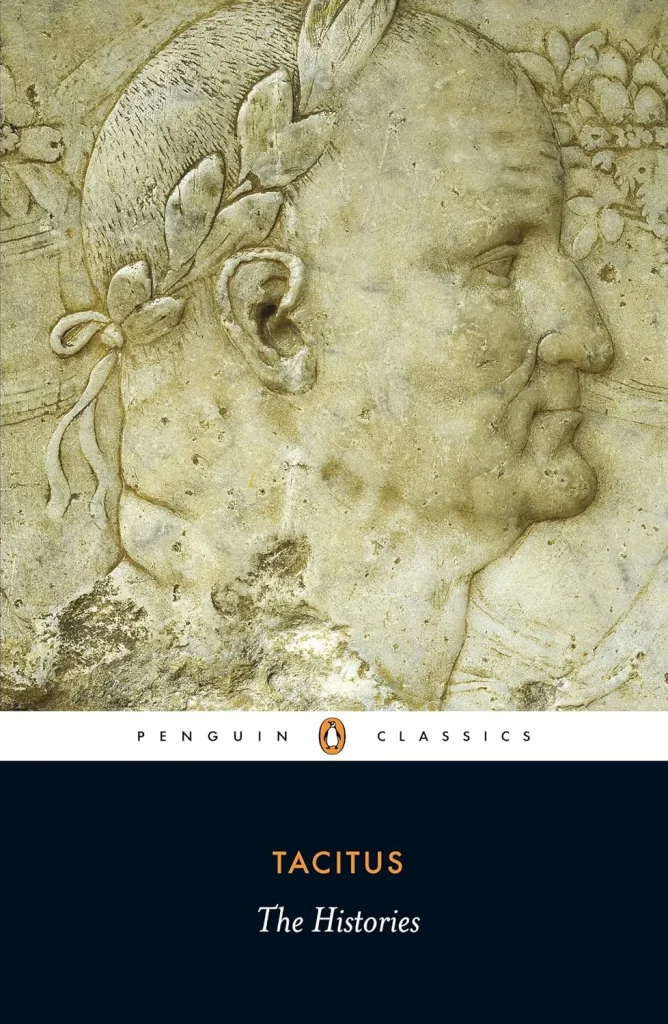
Best for: Reading the Romans in their own words — primary source history at its finest
Published: Originally c. AD 109 (Penguin Classics Edition: August 25, 2009)
Every list of books about ancient Rome eventually arrives at a primary source — the point where you stop reading about the Romans and start reading what the Romans themselves wrote. Tacitus is where that reading should begin.
Publius Cornelius Tacitus was a Roman senator and historian who lived and wrote in the late first and early second century AD. He had the unusual advantage — for a historian — of having personally participated in the system he was writing about. He held senior offices under several emperors, which gave him both access to information and a personal understanding of how power actually operated in Rome that no modern historian can fully replicate.
The Histories covers the Year of the Four Emperors — AD 69 — the year following Nero’s suicide in which four different men claimed the emperorship in succession, producing a civil war that brought the empire to the edge of collapse. It is among the most dramatic single years in Roman history and Tacitus covers it with a narrative intensity that reads as contemporary rather than ancient.
What you will learn: How Roman contemporaries understood and described political events — the language, the values, the assumptions embedded in how they explained what happened. The specific events of AD 69 in extraordinary detail. And Tacitus’s famous pessimistic intelligence — his conviction that power corrupts with predictable regularity, that flattery and fear distort every account produced close to the center of power, and that the historian’s job is to puncture those distortions with honesty.
The quality that makes Tacitus essential: His prose. Even in translation, Tacitus writes with an aphoristic compression that produces sentences worth lingering over. His character portraits are devastating. His account of how armies behave in civil war — the looting, the betrayals, the casual brutality — has a journalistic honesty that modern war reporting aspires to.
A note on translation: The Penguin Classics edition translated by W.H. Fyfe and revised by D.S. Levene is the most accessible modern translation — it preserves the energy of the original without sacrificing accuracy. If you find Fyfe’s version occasionally demanding, the Oxford World’s Classics translation by Clifford Moore and John Jackson is a useful alternative.
From my experience: Reading Tacitus after reading Graves’s I, Claudius produces an interesting doubling — you see how Graves used Tacitean material and where he departed from it. The historical Tiberius in Tacitus is considerably more ambiguous than Graves’s version. The gap between the two is itself a lesson in how evidence becomes interpretation.
Who this is for: Readers who have worked through the fiction and the analytical history and want to encounter the Romans directly. Also essential for students of history, political science, or journalism who want to understand where the tradition of clear-eyed institutional observation comes from.
5. Barbarian Migrations and the Roman West, 376–568 — Guy Halsall
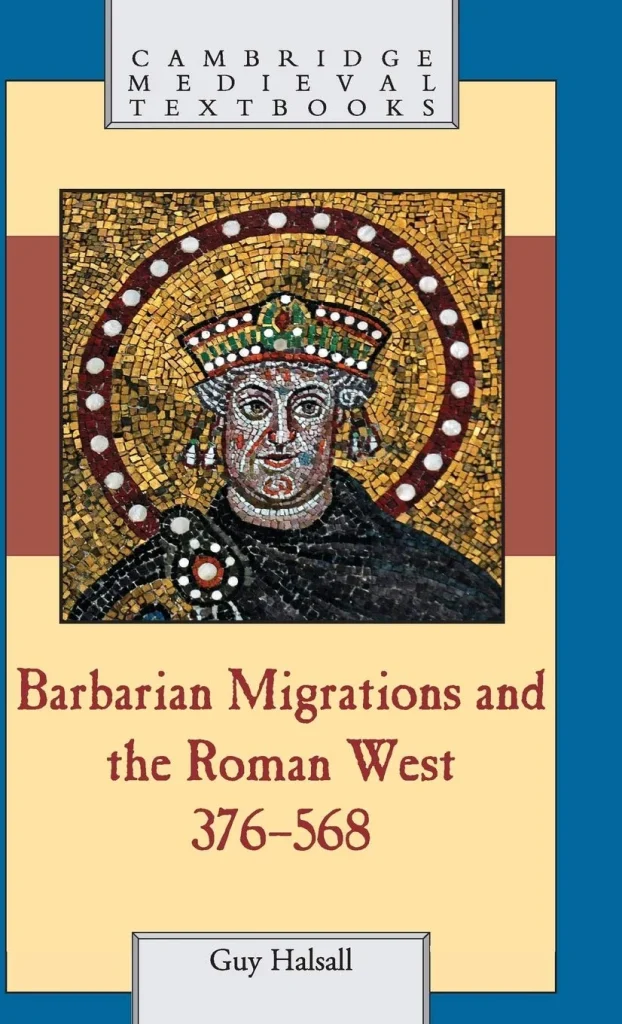
Best for: The most rigorous scholarly account of Rome’s transformation into medieval Europe
Published: 2007 (Illustrated Edition available)
This is the most demanding book on the list and the most rewarding for readers who want to understand not just why Rome fell but what actually happened — on the ground, in the communities, across the territories that had been the Western Empire — during the two centuries in which the Roman West became something else.
Guy Halsall is a professor of history at the University of York who has spent his career working at the intersection of late Roman history and early medieval history. Barbarian Migrations and the Roman West is his major synthetic work — a comprehensive account of the period from the Gothic crossing of the Danube in 376 to the Lombard settlement of Italy in 568, integrating both historical sources and archaeological evidence.
His central argument challenges the conventional framing in a way that complements Goldsworthy’s work. The conventional picture presents barbarian migrations as the cause of Rome’s fall — external populations moving into Roman territory and overwhelming a weakened state. Halsall inverts this relationship: the fall of Roman political structures in the West, he argues, produced the migrations rather than being produced by them. As the empire’s administrative capacity collapsed, the peoples who had been settled along and beyond its frontiers — many of whom had been integrated into Roman military and economic systems for generations — moved into the vacuum. The migrations were as much a consequence of collapse as a cause of it.
What you will learn: The specific events and processes of the fifth and sixth centuries in the western provinces — Gaul, Spain, Britain, North Africa, Italy — in detail that most general Roman histories skip past. The archaeological evidence for how communities actually changed during this period — what the material culture shows about continuity and change in daily life. And the argument that the transformation of the Roman West into early medieval Europe was more gradual, more locally variable, and more Roman than the conventional “fall” narrative suggests.
A note on difficulty: This book is written for an academic audience and assumes some prior knowledge of the period. Reading it after Goldsworthy’s How Rome Fell provides essential context. Halsall’s argument and Goldsworthy’s are complementary — Goldsworthy explains why the Western administration collapsed, Halsall explains what happened after it did.
From my experience: The sections on how local communities in Gaul and Spain adapted to the disappearance of Roman central authority — maintaining aspects of Roman law, culture, and self-organization while integrating new Germanic ruling groups — reminded me of how organizations respond to the collapse of central management. The resilience is in the local networks, not the institutional hierarchy. That pattern recurs.
Who this is for: Serious students of Roman history who want the most rigorous available account of the transformation rather than the fall. Also invaluable for readers interested in the origins of medieval Europe. This is not a casual read — but for the right reader it is the most intellectually rewarding book on this list.
How to Build Your Roman Reading Journey
These five books cover different entry points, different eras, and different levels of difficulty. Here is the sequence that gives most readers the richest experience:
Start here if you are new to Roman history: I, Claudius — fiction first, history second. It gives you the emotional investment and the cast of characters that makes everything else more meaningful.
Then read: The First Man in Rome — go back to the Republic and understand the world that preceded the Empire you just read about.
Then read: How Rome Fell — now you have the arc from Republic to Empire. Goldsworthy explains how the structure that Claudius and Marius inhabited eventually collapsed.
Then read: The Histories — by this point you understand the context. Reading Tacitus after the fiction and the analytical history is a completely different experience from reading him cold.
Then read: Barbarian Migrations — the final piece. What actually happened in the territories after the administration fell.
This sequence takes you from the most accessible to the most demanding and from the most narrative to the most analytical — which is both the intellectually logical and the most enjoyable order.
The Recurring Patterns Worth Watching For
As you read, several themes recur across all five books regardless of era or author. Watching for them across the full reading experience produces insights that no single book provides:
The tension between individual genius and institutional health. Marius’s military reforms saved Rome from the Cimbri and Teutones and ultimately destabilized the Republic. Sulla’s dictatorship restored senatorial order and created the conditions for Caesar. Individual effectiveness and institutional sustainability pull in opposite directions with remarkable consistency across Roman history.
The gap between the performance of power and its substance. Claudius performs weakness to survive. Emperors perform strength while their real authority hollows out. The Roman state maintains the forms of republican governance while operating as an autocracy. The distance between how power presents itself and how it actually works is a constant Roman theme.
The role of the frontier. Rome’s relationship with the peoples on and beyond its borders was always more complex than conqueror and conquered — trade, military integration, cultural exchange, and mutual dependence ran alongside conflict. Understanding this complexity changes how you read both the Republic’s expansion and the Empire’s eventual transformation.
Institutional memory and its loss. Again and again in Roman history, an institution that worked well in one context became dysfunctional when circumstances changed — because the people operating it had learned procedures without understanding purposes. The Senate that governed a city-state could not govern an empire. The army that defended fixed frontiers could not adapt to fluid migration. This pattern is not uniquely Roman.
Frequently Asked Questions
What is the best book about ancient Rome for beginners?
I, Claudius by Robert Graves is the most accessible and compelling entry point for readers new to Roman history — it introduces the major figures and dynamics of the early Empire through an engaging fictional memoir that draws directly on ancient sources. Readers who want non-fiction first should start with Adrian Goldsworthy’s How Rome Fell, which assumes no prior knowledge and explains the context as it builds its argument.
What is the best novel set in ancient Rome?
I, Claudius by Robert Graves is the consensus answer — it is one of the most celebrated historical novels in the English language and the standard against which other Roman fiction is measured. The First Man in Rome by Colleen McCullough is the strongest alternative, particularly for readers interested in the Republic rather than the Empire.
Is Tacitus difficult to read?
In a good modern translation — particularly the Penguin Classics edition — Tacitus is demanding but rewarding. His sentences are compressed and aphoristic, which means they reward slow reading rather than rapid skimming. Reading him after the fiction and analytical history on this list makes him considerably more accessible than reading him cold.
What is the difference between the Roman Republic and the Roman Empire?
The Roman Republic was governed by elected magistrates and a Senate — a system of shared power with significant checks and balances that functioned from approximately 509 BC to 27 BC. The Roman Empire replaced this with autocratic rule under a single emperor, beginning with Augustus in 27 BC and lasting in the West until AD 476 and in the East (as the Byzantine Empire) until 1453.
Why did Rome fall?
This is one of history’s most debated questions and the books on this list represent different positions within that debate. Goldsworthy emphasizes internal institutional decay — the prioritization of personal and factional survival over the broader good across multiple generations. Halsall emphasizes the complex interaction between internal collapse and external migration. The honest answer is that both factors operated across a very long period and the fall of the Western Empire specifically involved the particular convergence of circumstances in the fifth century rather than a single cause.
Are there good books about Julius Caesar specifically?
Caesar appears as a character in Colleen McCullough’s Masters of Rome series — most directly in Fortune’s Favorites, Caesar’s Women, Caesar, and The October Horse. For non-fiction, Goldsworthy’s Caesar (a separate biography, not on this list) is the most comprehensive modern account. Adrian Goldsworthy has also written biographies of Augustus and Antony and Cleopatra that form a coherent supplementary reading cluster.
What should I read after these five books?
For more Roman fiction: Steven Saylor’s Roma Sub Rosa mystery series featuring Gordianus the Finder, and Lindsey Davis’s Falco series, offer immersive Roman world-building in a lighter register than Graves or McCullough. For more analytical history: Tom Holland’s Rubicon covers the fall of the Republic in accessible, narrative non-fiction form. Mary Beard’s SPQR provides a cultural history of Rome that challenges several conventional assumptions about what Roman civilization actually was.
Final Verdict
Rome rewards the reader who stays with it. The history is long, the cast of characters enormous, and the stakes — at least from the perspective of people who lived through it — as high as history ever gets. But the patterns Rome reveals, the specific ways that human ambition, institutional design, and external pressure interact across centuries, are as relevant as anything you will find in contemporary political analysis or organizational theory.
Start with I, Claudius. Let Claudius introduce you to his murderous family with his characteristic dry intelligence. Then follow the reading sequence above until you reach Halsall’s account of what grew from Rome’s transformation. By the time you finish all five you will understand why the Romans called their city the Eternal City — not because it did not fall, but because what it was never entirely went away.

Leave a Reply