Tom Robbins Books in Order: A Journey Through His Novels, Oddities, and Memoir
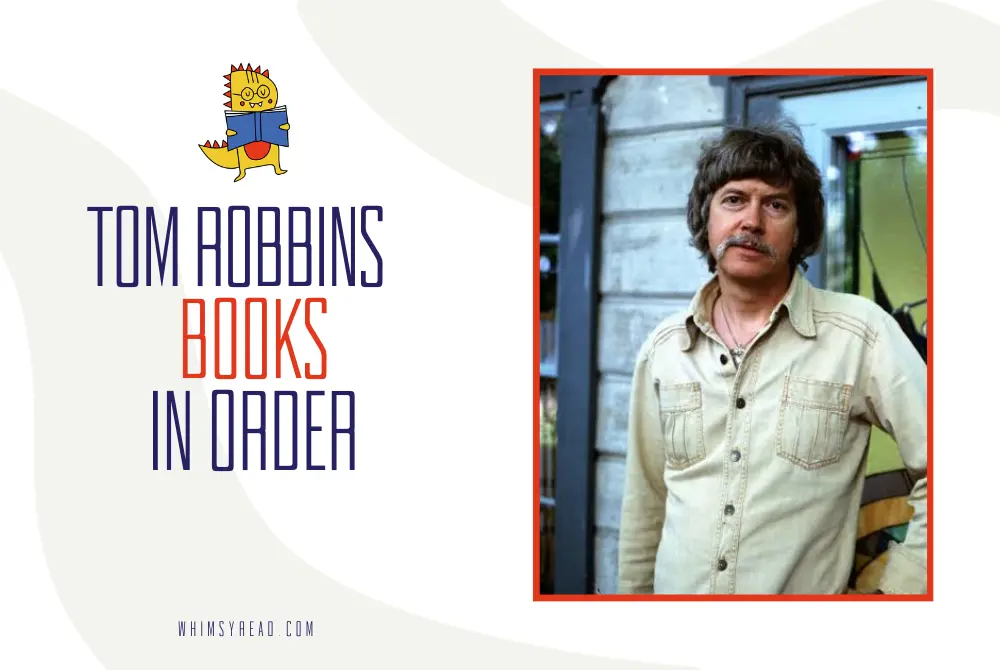
Tom Robbins (1932–2025) made a literary career out of refusing to take the obvious route. His novels mingle philosophical questions with mischievous jokes, uninhibited romance, eccentric characters, irreverent commentary on religion, and unlikely incidents that make perfect sense only within the peculiar logic of his stories. Rather than keeping realism and fantasy in separate compartments, he delighted in letting the two argue on the same page.
The American novelist grew up in North Carolina and Virginia, later working as a journalist and arts critic in the Pacific Northwest. His first novel appeared in 1971, at a moment when countercultural ideas about personal freedom, spirituality, and authority were finding new expression in literature. Understanding that background makes his fiction easier to place, though readers need not know the history of the 1960s to enjoy its humor.
Tom Robbins Novels in Publication Order
Robbins wrote eight full-length novels, all standalones. The original publication years below refer to the first book releases rather than later paperback, ebook, or audiobook editions.
| Early novels | Later novels |
| 1. Another Roadside Attraction (1971) | 5. Skinny Legs and All (1990) |
| 2. Even Cowgirls Get the Blues (1976) | 6. Half Asleep in Frog Pajamas (1994) |
| 3. Still Life with Woodpecker (1980) | 7. Fierce Invalids Home from Hot Climates (2000) |
| 4. Jitterbug Perfume (1984) | 8. Villa Incognito (2003) |
1. Another Roadside Attraction (1971)
Amanda and John Paul Ziller turn a roadside zoo and hot-dog stand into a gathering place for performers, spiritual experimenters, and other unconventional personalities. Their strange enterprise becomes even more provocative when a discovery involving a purported holy corpse raises questions about organized religion, belief, and what society is prepared to accept as truth. Robbins’s debut captures the playful spirit of the counterculture while setting the tone for his later philosophical satire.
2. Even Cowgirls Get the Blues (1976)
Sissy Hankshaw is born with extraordinarily large thumbs, an unusual physical characteristic that helps make her a legendary hitchhiker. Her travels lead her into the world of the Rubber Rose Ranch, where rebellious cowgirls, endangered whooping cranes, and unconventional relationships test established ideas about freedom and femininity. This wandering, comic novel became one of Robbins’s signature works and was adapted into a 1993 film directed by Gus Van Sant.
3. Still Life with Woodpecker (1980)
Leigh-Cheri, a princess from an exiled royal family living in the Pacific Northwest, falls in love with Bernard Mickey Wrangle, an outlaw bomber known as the Woodpecker. Their improbable romance unfolds amid environmental activism, political rebellion, and the recurring mystery of a Camel cigarette package. The novel is both a mischievous love story and an exploration of the question of how love can endure in a world committed to disruption.
4. Jitterbug Perfume (1984)
An ancient king named Alobar and his companion Kudra pursue a way to escape death, while modern perfumers in Paris, New Orleans, and Seattle compete to discover a remarkable scent. A mysterious blue bottle links these stories across centuries, bringing the characters into an extravagant meditation on immortality, desire, and the senses. Its sprawling timeline and vivid perfume imagery make Jitterbug Perfume a natural choice for readers who enjoy myth-infused literary fantasy.
5. Skinny Legs and All (1990)
Artist Ellen Cherry Charles and her husband, Boomer Petway, become entangled in New York City’s art scene, where an Arab and a Jewish businessman operate a restaurant near the United Nations. Meanwhile, an unlikely group of animated objects—including a spoon, a dirty sock, and a can of beans—undertakes its own consequential journey. Robbins uses these converging stories to examine religious conflict, political extremism, art, and the illusions people build around their beliefs.
6. Half Asleep in Frog Pajamas (1994)
Gwendolyn Mati, an ambitious Seattle stockbroker, sees her carefully managed life begin to unravel when the market collapses just before Easter weekend. Over three chaotic days, she encounters a missing psychic, an enigmatic stranger, and events that challenge her confidence in material success. Written in the unusual second-person perspective, the novel makes readers feel as though they are personally caught inside its escalating absurdity.
7. Fierce Invalids Home from Hot Climates (2000)
Switters is an intelligence operative whose contradictions are almost as remarkable as the international trouble he attracts: he works for the government while questioning authority and moves between elaborate schemes and genuine philosophical curiosity. His adventures across multiple continents draw him into danger, desire, religious mysteries, and an increasingly bizarre predicament. This globe-trotting novel brings the pace of a spy adventure to Robbins’s characteristic blend of satire and spiritual speculation.
8. Villa Incognito (2003)
Several Americans listed as missing after the Vietnam War have chosen to remain out of sight in Southeast Asia, where their lives intersect with secret identities and a mysterious Japanese folkloric figure. Their story reaches across Laos, Thailand, and the United States, weaving together wartime history, performance, disguise, and family secrets. Villa Incognito is Robbins’s final full-length novel and offers a compact example of his fascination with the difference between who people are and who they pretend to be.
Tom Robbins’s Other Books and Shorter Works
Robbins’s bibliography extends beyond novels. The following works are useful additions to a complete reading list, but they should not be mistaken for further installments in a continuing fictional series.
Wild Ducks Flying Backward (2005) — Essays, Stories, and Other Writings
This collection brings together Robbins’s shorter journalism, essays, observations, poems, and fiction, allowing readers to experience his voice outside the structure of a novel. Its subjects range from art and music to literature, food, and cultural attitudes, with the same imaginative wordplay that distinguishes his longer books. It is particularly rewarding after a few novels, when readers can recognize his recurring interests in a different format.
B Is for Beer (2009) — Illustrated Novella
Six-year-old Gracie Perkel is curious about the adult world’s fascination with beer, especially after interactions with her beer-loving Uncle Moe. A visit from the Beer Fairy turns her curiosity into a playful journey through brewing, grown-up habits, and the complications surrounding alcohol. Though sometimes listed among Robbins’s novels, this short illustrated work is better distinguished from his eight full-length novels and should not be confused with an ongoing Beer! series.
Tibetan Peach Pie: A True Account of an Imaginative Life (2014) — Memoir
Robbins looks back on his upbringing, education, military service, journalism, relationships, and eventual life as a novelist through a sequence of lively personal recollections. The book moves between actual experiences and his familiar digressions, making it an unconventional autobiography rather than a straightforward chronological life story. Published in 2014, it was the last book he released during his lifetime.
Guy Anderson (1965) — Early Art Monograph
Before publishing fiction, Robbins wrote a short monograph about Pacific Northwest painter Guy Anderson, issued by Gear Works Press in 1965. This rare art booklet is a notable early publication rather than a novel or a necessary stop in the general reading order. Readers exploring his literary works can begin in 1971 without seeking out the collectible volume.
Do Tom Robbins’s Books Need to Be Read in Order?
Not for plot continuity. Unlike authors whose books follow one detective, family, or fantasy world, Robbins created separate casts and situations in each of his eight full-length novels. A reader who discovers Jitterbug Perfume first will not need information from Still Life with Woodpecker to understand it.
Publication order is still rewarding because it reveals how his approach changed. The early novels are closely associated with the sensibilities of the 1960s and 1970s counterculture, the middle books push further into myth, animated objects, and narrative experimentation, and his final novels explore global travel, espionage, identity, and disguise.
Which Tom Robbins Book Should You Read First?
There is no single correct entry point, because his books have noticeably different moods and storytelling ambitions.
- For a lively introduction to his imagination: Start with Jitterbug Perfume. Its perfume-making plot, interwoven timelines, and questions about mortality show the breadth of his fictional world.
- For romance and philosophical comedy: Choose Still Life with Woodpecker. The Leigh-Cheri and Woodpecker relationship makes its absurdity feel anchored in an emotional conflict.
- For American counterculture fiction: Begin with Another Roadside Attraction or Even Cowgirls Get the Blues. Both capture the rebellious spirit and social experimentation strongly associated with his early career.
- For political and religious satire: Try Skinny Legs and All. Its combination of New York art, Middle Eastern politics, and talking objects is unusually ambitious.
- For a shorter, late-career novel: Consider Villa Incognito. It delivers his interest in masks, identity, and mythology without the sprawling size of some earlier books.
If you prefer a more conventional plot, Robbins may require a little adjustment: his digressions, jokes, and unexpected shifts in perspective are part of the experience rather than interruptions to it.
What Makes Tom Robbins’s Writing Distinctive?
Playful language with serious questions underneath
Robbins is associated with postmodern literary fiction, satirical comedy, and the American counterculture, but those labels only partly describe his style. His paragraphs often move from an elaborate metaphor to a joke about social convention, then suddenly into a question about faith, death, or desire. The humor can be extravagant, yet the philosophical questions are rarely accidental.
Freedom, authority, and unconventional relationships
His characters often resist the expectations of governments, religions, employers, or romantic partners. Sissy Hankshaw’s independence in Even Cowgirls Get the Blues, the outlaw romance of Still Life with Woodpecker, and Switters’s conflicting loyalties in Fierce Invalids Home from Hot Climates all explore the tension between personal freedom and social responsibility. The books do not always provide comfortable answers, which is part of their appeal to readers interested in challenging literary fiction.
Mythology and everyday objects treated as important
Perfume can become the key to immortality, an ordinary cigarette package can sustain a metaphysical mystery, and a tin of beans can take part in a world-changing journey. Robbins often makes the familiar seem strange and the impossible seem commonplace. Readers who enjoy surrealism, magical realism, and philosophical fantasy may recognize aspects of those traditions in his work, even though his novels resist neat genre categories.
A Note on Tom Robbins and Similarly Named Authors
Some online book catalogues incorrectly attach Mob Boss: The Life of Little Al D’Arco, the Man Who Brought Down the Mafia (2013) to the novelist’s bibliography. That crime biography was co-written by Tom Robbins the New York investigative journalist, a different person from the novelist who wrote Jitterbug Perfume; it does not belong on this reading list. Similarly, new editions and omnibus collections should not be counted as newly written novels.
Frequently Asked Questions About Tom Robbins Books
How many novels did Tom Robbins write?
Tom Robbins wrote eight full-length novels, published between 1971 and 2003. Some bibliographies give a total of nine because they include the illustrated novella B Is for Beer (2009) alongside the novels. His other well-known books include Wild Ducks Flying Backward (2005), a collection of shorter work, and Tibetan Peach Pie (2014), his memoir.
What was Tom Robbins’s first book?
His debut novel was Another Roadside Attraction, published in 1971, and that is the appropriate starting point for a chronological reading of his fiction. Technically, he had already published Guy Anderson, a short monograph on the painter, in 1965. The earlier work is a rare art publication rather than an installment in his literary fiction catalogue.
What was Tom Robbins’s last novel?
Villa Incognito, originally published in 2003, was his final full-length novel. He subsequently published the collection Wild Ducks Flying Backward in 2005, the novella B Is for Beer in 2009, and the memoir Tibetan Peach Pie in 2014. Those later books are different kinds of writing, so a list of his novels correctly ends with Villa Incognito.
What is Tom Robbins’s most recent book?
Tibetan Peach Pie: A True Account of an Imaginative Life (2014) is the most recent book he published during his lifetime. It is autobiographical nonfiction rather than a novel, and it covers experiences from his childhood through his writing career. Robbins died on February 9, 2025, at the age of 92; there is no confirmed posthumous novel in this guide as of November 2026.
Are Tom Robbins’s books connected or part of a series?
His eight full-length novels are standalones with their own central characters and stories, not installments in a numbered series. They are connected through recurring ideas—freedom, sexuality, spirituality, alternative ways of living—and a distinctive narrative voice, rather than through a shared plot. Reading them out of order does not spoil the endings of earlier books.
Which Tom Robbins book is usually recommended for beginners?
Jitterbug Perfume is an inviting starting point if you enjoy imaginative literary fiction with mythology and intersecting storylines. Still Life with Woodpecker may be a better choice if you want a more concentrated romantic plot, while Even Cowgirls Get the Blues introduces the free-spirited countercultural sensibility that made him famous. The best first book depends on whether you prefer adventurous ideas, unconventional romance, or social satire.
Is B Is for Beer a children’s book or an adult book?
It deliberately plays with both audiences, using a childlike narrative to examine a subject generally associated with adults. Six-year-old Gracie and the Beer Fairy provide the story’s imaginative framework, but its humor and explanations are also directed toward older readers. Because alcohol is central to the book, parents should decide whether it suits a particular younger reader rather than treating the illustrated format as an automatic age recommendation.
Was Even Cowgirls Get the Blues made into a movie?
Yes. The novel was adapted into a 1993 film directed by Gus Van Sant, with Uma Thurman playing Sissy Hankshaw. As with most adaptations, the film provides a different experience from Robbins’s language-driven original, where digressions and philosophical commentary are a major part of the appeal.
Is Tom Robbins considered a magical realism author?
Robbins is more commonly discussed as a postmodern and countercultural novelist, but his work often includes fantastic events, mythic figures, and impossible situations presented within recognizable modern settings. These features can appeal to readers of magical realism and surrealist fiction, particularly in Jitterbug Perfume and Skinny Legs and All. Neither label captures everything he does, because satire, romance, and philosophical speculation are just as central to his style.
Should I read Tibetan Peach Pie before or after the novels?
You can read the memoir independently, but it may be more satisfying after several novels. Learning about his work as a journalist and arts critic, his travels, and his personal experiences gives additional context to the themes in his fiction. Readers interested primarily in his life rather than his fictional worlds can safely begin with the memoir.
Final Thoughts
Tom Robbins’s books reward readers who enjoy language as much as plot. His eight novels move from counterculture comedy in Another Roadside Attraction to the mythology, international settings, and identity games of Villa Incognito, while his shorter works and memoir reveal other sides of his writing.
For a complete journey, follow the novels in their original publication order, then explore Wild Ducks Flying Backward, B Is for Beer, and Tibetan Peach Pie. If you simply want one unforgettable introduction, Jitterbug Perfume or Still Life with Woodpecker offers a natural place to discover why his unusual literary voice continues to attract readers.

Leave a Reply