
Mary Stewart Books in Order: All Novels, Arthurian Books, and More
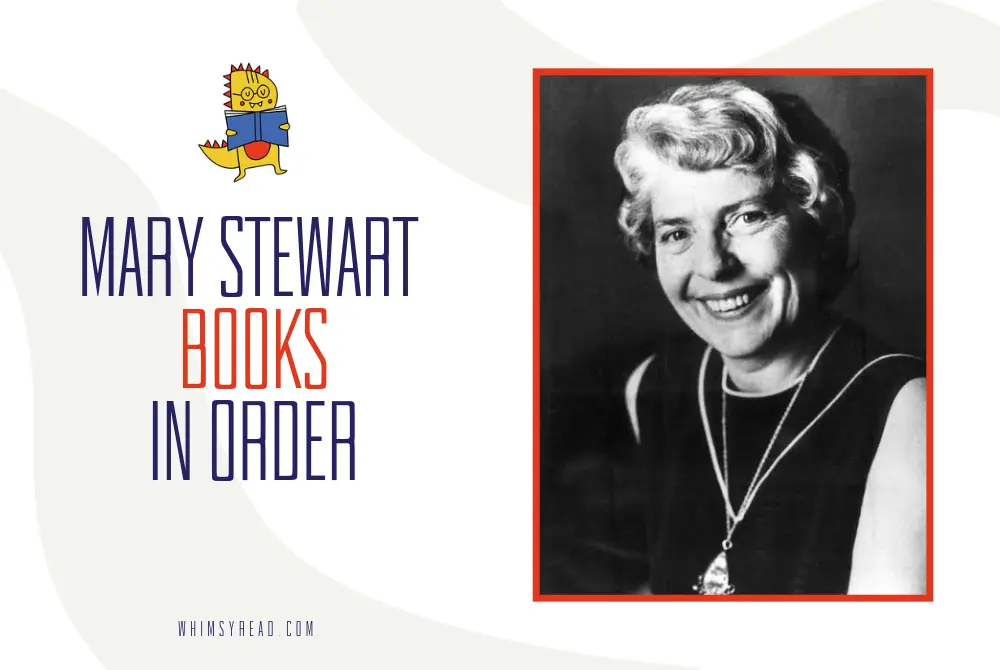
Mary Stewart had a particular gift for making beautiful places feel dangerous. A sunlit Mediterranean island, a remote English country house, or a quiet village could become the setting for secrets, deception, and a heroine who discovers that her holiday or ordinary life is about to turn into something far more complicated.
She is remembered for two distinct kinds of storytelling. Her romantic suspense novels feature intelligent women caught in dangerous situations, while her Arthurian books reimagine the legends of Merlin and King Arthur with an emphasis on history, character, and the possibility of magic.
The reading order depends on which side of her writing interests you. The Arthurian books should be read in sequence, but most of her romantic suspense novels are standalones. This guide covers both, along with her children’s fiction and other published works.
Mary Stewart’s Arthurian Saga in Order
Mary Stewart’s Arthurian Saga reimagines the legends of Merlin and King Arthur through historical fantasy. The first three novels form the Merlin Trilogy, while the fourth shifts the focus toward Arthur’s reign and the consequences of the choices made by the previous generation. The fifth returns to the Arthurian world through a separate adventure.
Read all five in publication order.
1. The Crystal Cave (1970)
Merlin narrates his own life, beginning with his childhood and the strange experiences that set him apart from other people. As he grows older, his unusual abilities draw him into the political struggles of Britain and the events surrounding Uther Pendragon.
Rather than presenting Merlin simply as a mysterious wizard, Stewart gives him a human history, an education, and a developing understanding of his gifts. The result is an atmospheric introduction to the Arthurian legend that emphasizes Merlin’s perspective.
2. The Hollow Hills (1973)
The second novel continues Merlin’s story as he becomes more deeply involved in the events surrounding Arthur’s birth and future. His knowledge and abilities make him an influential figure, but the political and personal stakes surrounding the young prince are considerable.
This book builds directly on The Crystal Cave. Reading the first novel beforehand makes Merlin’s decisions and the developing relationships much easier to appreciate.
3. The Last Enchantment (1979)
The third installment follows Merlin as he becomes an important adviser in Arthur’s world. His ambitions, loyalties, and understanding of the future shape his role in the kingdom.
This novel completes the original Merlin Trilogy. It is particularly rewarding for readers who enjoy Arthurian stories that explore the people behind the legends rather than relying only on familiar magical episodes.
4. The Wicked Day (1983)
The focus shifts to Mordred, whose life becomes entangled with the fate of Arthur’s kingdom. Stewart explores the events leading toward the tragedy associated with Arthur’s reign, presenting familiar legends through the experiences and motivations of the people caught within them.
The book moves beyond Merlin’s personal story to examine the consequences of prophecy, family relationships, and political conflict.
5. The Prince and the Pilgrim (1995)
This later novel returns to the Arthurian world for a separate adventure involving a young prince and a pilgrim. It expands Stewart’s treatment of the legends without functioning as a direct continuation of The Wicked Day.
Although the novel can be approached as a more independent story, reading the earlier books first provides useful context for Stewart’s version of the Arthurian world.
Arthurian Saga reading checklist
- The Crystal Cave
- The Hollow Hills
- The Last Enchantment
- The Wicked Day
- The Prince and the Pilgrim
Where should you start? Begin with The Crystal Cave. The first three novels are especially closely connected, and the original publication order is the clearest way to follow Merlin’s story before moving into the later Arthurian adventures.
Mary Stewart’s Romantic Suspense Novels in Publication Order
Stewart’s romantic suspense novels are mostly standalones. They combine mystery, romance, travel, atmospheric settings, and heroines who must use their intelligence to understand dangerous situations.
You can read them independently, but the following publication order is useful if you want to follow the development of her career.
1. Madam, Will You Talk? (1954)
Charity Selborne, a young widow, travels to Provence for a holiday. Her encounter with a troubled boy and his father draws her into a situation involving danger, suspicion, and a race to uncover the truth.
This debut establishes several features that would become familiar in Stewart’s later work: an observant heroine, a compelling location, and suspense that grows from personal relationships.
2. Wildfire at Midnight (1956)
Set on the Isle of Skye, this novel brings a murder mystery into the isolated atmosphere of a Scottish hotel. Gianetta Brooke, a fashion model, becomes involved in a case where the people staying nearby may have more to hide than they admit.
The setting is essential to the suspense. The island’s landscape and the limited circle of possible suspects create an unsettling atmosphere.
3. Thunder on the Right (1957)
Jennifer Silver travels to France to visit her cousin, only to discover that the circumstances surrounding her relative’s life are not what she expected. Her search for answers leads into a mystery involving deception and danger.
The novel combines travel, family relationships, and the uncertainty of trying to understand a situation from incomplete information.
4. Nine Coaches Waiting (1958)
Linda Martin accepts a position as governess to a young French boy at an imposing château. What initially seems like an attractive opportunity becomes increasingly troubling as she notices signs that the household may be hiding a dangerous secret.
The novel is one of Stewart’s best-known romantic suspense stories. Its Gothic atmosphere, isolated setting, and heroine’s growing suspicions make it an excellent introduction to her standalone fiction.
5. My Brother Michael (1959)
Camilla Haven travels to Greece, where a seemingly ordinary journey brings her into contact with a man connected to a mystery from the past. As the story develops, she finds herself drawn into danger and a search for the truth.
The Greek setting adds to the book’s appeal, while the plot combines travel, intrigue, and romantic suspense.
6. The Ivy Tree (1961)
Mary Grey encounters a family whose circumstances create an unusual opportunity: she resembles a missing heiress and may be able to take the woman’s place. What follows is a complicated game of identity, deception, and family secrets.
The premise allows Stewart to explore how appearances shape people’s expectations and how easily a convincing performance can become dangerous.
7. The Moon-Spinners (1962)
Nicola Ferris is working in Crete when she becomes involved in a mystery connected to a missing young man and his family. Her holiday turns into an investigation that takes her through the island’s landscapes and into a dangerous situation.
This is one of Stewart’s most recognizable novels and inspired the 1964 Disney film of the same name. It is a strong choice for readers who enjoy travel-centered suspense.
8. This Rough Magic (1964)
Lucilla Carstairs visits the Greek island of Corfu, where her surroundings become the backdrop for a mystery involving a famous actor, a dolphin, and suspicious events. The novel combines the glamour of the theatrical world with the danger of a more personal investigation.
The island setting and the heroine’s observations create a suspenseful story in which seemingly unrelated details gradually acquire significance.
9. Airs Above the Ground (1965)
Vanessa March travels to Austria after becoming concerned about her husband’s behavior. Her investigation brings her into contact with a traveling circus and a series of strange events that complicate her search for answers.
Horses and the world of circus performance add a distinctive element to the story, while the mystery centers on trust, identity, and the gap between appearances and reality.
10. The Gabriel Hounds (1967)
Christy Mansel travels to Lebanon to visit her elderly cousin, who lives in a grand house with a mysterious reputation. The visit brings her into a world of family secrets, unusual relationships, and potential danger.
The Middle Eastern setting gives the novel a distinctive atmosphere. As in many of Stewart’s books, the heroine must learn which people can be trusted and what the household is concealing.
11. Touch Not the Cat (1976)
Bryony Ashley belongs to a family with a mysterious inheritance: a psychic bond that allows members of the family to communicate in unusual ways. After a death in the family, Bryony begins receiving messages that may help her uncover the truth.
The novel combines romantic suspense with a supernatural element, making it a particularly interesting choice for readers who enjoy mysteries that leave room for the unexplained.
12. Thornyhold (1988)
Gilly Ramsey inherits a cottage in the English countryside from a relative she barely knew. As she settles into her new surroundings, she discovers that the house and its history carry unusual associations.
The novel blends mystery, romance, and a subtle sense of magic. Its quieter pace and countryside setting make it different from Stewart’s more overtly dangerous travel adventures.
13. Stormy Petrel (1991)
Rose Fenemore spends time on a remote Scottish island, where a seemingly peaceful visit becomes entangled with suspicious behavior and personal complications. The isolated location and unsettled weather add to the tension.
Stewart again uses landscape as part of the mystery, creating a story in which the environment contributes to the sense of uncertainty.
14. Rose Cottage (1997)
Rose Fenemore returns to a cottage associated with her childhood and begins looking into a mystery connected to her past. The story turns on memories, family history, and the possibility that the truth about earlier events has never been fully understood.
This was Stewart’s final novel. It brings her career in romantic suspense to a close with the familiar ingredients of place, personal history, and a mystery that gradually comes into focus.
Mary Stewart’s Novella and Shorter Fiction
Stewart also wrote shorter fiction that deserves a place in a complete reading guide.
The Wind Off the Small Isles (1968)
This novella follows a writer who travels to a remote Scottish island and becomes involved in an encounter that combines atmosphere, romance, and uncertainty.
It offers a shorter way to experience Stewart’s descriptive style and her interest in isolated settings. Since it is not part of the Arthurian Saga, it can be read at any point in her bibliography.
The work has also appeared in editions paired with The Lost One. Check the contents of a particular edition if you are collecting her shorter fiction, because combined editions may be catalogued differently.
Mary Stewart’s Children’s Books in Order
Stewart wrote fiction for younger readers as well as adults. Her children’s books retain her interest in mystery, unusual encounters, and imaginative settings, but they are aimed at a different audience.
1. The Little Broomstick (1971)
Mary Smith discovers a strange flower that gives her unusual abilities and leads her to a school of magic. Her adventure brings her into contact with people whose intentions are not as harmless as they first appear.
The book became widely known through the animated film Mary and the Witch’s Flower (2017), which was inspired by Stewart’s story.
2. Ludo and the Star Horse (1974)
Ludo’s encounter with a mysterious horse leads him into an imaginative adventure. The story draws on fantasy and wonder while retaining the accessible storytelling of Stewart’s children’s fiction.
3. A Walk in Wolf Wood (1980)
Two children enter a mysterious wood and become involved in an adventure that blurs the boundary between the familiar world and something more magical.
The book is a good option for younger readers who enjoy fairy-tale elements, woodland settings, and a sense of discovery.
4. The Castle of Danger (1981)
This children’s book is a simplified adaptation of Stewart’s adult novel Nine Coaches Waiting. It presents the core adventure in a form intended for younger readers.
Because it adapts an earlier novel, it is worth treating it as a companion version rather than an entirely separate story when building a complete collection.
Mary Stewart’s Poetry Collection
Frost on the Window and Other Poems (1990)
This collection showcases a different side of Stewart’s writing. Readers who know her mainly through suspense and Arthurian fantasy can use it to explore her work in poetry.
It is not connected to any of her novel series and can be read independently.
Mary Stewart Books in Publication Order: A Quick Reference
This table brings together her main adult novels and novella in approximate original publication order. Children’s books and poetry are listed separately above so that readers can easily distinguish her different kinds of work.
| Year | Title | Category |
| 1954 | Madam, Will You Talk? | Romantic suspense |
| 1956 | Wildfire at Midnight | Romantic suspense |
| 1957 | Thunder on the Right | Romantic suspense |
| 1958 | Nine Coaches Waiting | Romantic suspense |
| 1959 | My Brother Michael | Romantic suspense |
| 1961 | The Ivy Tree | Romantic suspense |
| 1962 | The Moon-Spinners | Romantic suspense |
| 1964 | This Rough Magic | Romantic suspense |
| 1965 | Airs Above the Ground | Romantic suspense |
| 1967 | The Gabriel Hounds | Romantic suspense |
| 1968 | The Wind Off the Small Isles | Novella |
| 1970 | The Crystal Cave | Arthurian Saga |
| 1976 | Touch Not the Cat | Romantic suspense |
| 1979 | The Last Enchantment | Arthurian Saga |
| 1983 | The Wicked Day | Arthurian Saga |
| 1988 | Thornyhold | Romantic suspense |
| 1991 | Stormy Petrel | Romantic suspense |
| 1995 | The Prince and the Pilgrim | Arthurian Saga |
| 1997 | Rose Cottage | Romantic suspense |
The Hollow Hills (1973) belongs between The Crystal Cave and The Last Enchantment in the Arthurian sequence. The children’s books and poetry collection have separate publication histories and are not part of the adult novel sequence.
Where Should You Start with Mary Stewart?
The right starting point depends on whether you prefer suspense or historical fantasy.
If you enjoy Arthurian legend: Start with The Crystal Cave. It gives Merlin a detailed personal history and sets up the events that continue through the first three books.
If you prefer romantic suspense: Start with Nine Coaches Waiting. Its Gothic setting, suspicious household, and resourceful heroine capture the qualities that made Stewart such an influential writer of romantic suspense.
If you like travel and mystery: Try The Moon-Spinners or My Brother Michael. Both make their locations an important part of the story.
If you prefer a quieter, slightly magical atmosphere: Thornyhold is a good choice, especially if you enjoy English countryside settings and family mysteries.
The standalone novels do not need to be read in order. You can choose the premise that appeals to you most and return to the rest later.
Frequently Asked Questions
How many books did Mary Stewart write?
Mary Stewart published 20 adult novels, including the five Arthurian Saga books and her romantic suspense novels. Her wider bibliography also includes children’s fiction, the novella The Wind Off the Small Isles, and a poetry collection. Counts vary depending on whether adaptations and combined editions are counted separately.
What is the first Mary Stewart book?
Madam, Will You Talk?, published in 1954, is generally listed as her first novel. It introduces the romantic suspense style that became a hallmark of her adult fiction.
What is the correct order of Mary Stewart’s Merlin books?
Read the Arthurian Saga in publication order: The Crystal Cave, The Hollow Hills, The Last Enchantment, The Wicked Day, and The Prince and the Pilgrim. The first three form the Merlin Trilogy.
Do Mary Stewart’s romantic suspense novels need to be read in order?
No. Most are standalones with different protagonists and settings. You can read Nine Coaches Waiting, The Moon-Spinners, or Touch Not the Cat without having read her other suspense novels.
Is The Little Broomstick part of a series?
No. It is a standalone children’s fantasy novel. It later inspired the animated film Mary and the Witch’s Flower, released in 2017.
What was Mary Stewart’s last novel?
Rose Cottage, published in 1997, was her final novel. It returns to the atmosphere of personal history, family secrets, and suspense that characterizes much of her earlier work.
Are Mary Stewart’s books still worth reading today?
Readers who enjoy atmospheric mysteries, resourceful heroines, travel settings, and character-driven fantasy may find her work especially rewarding. Her novels emphasize observation and suspense rather than relying solely on fast-paced action.
About Mary Stewart
Mary Stewart (1916–2014) was a British novelist best known for her romantic suspense novels and her Arthurian Saga. Before becoming a full-time writer, she studied English at Durham University and later taught there.
Her suspense novels helped establish a style of storytelling in which romance and mystery develop together. Her heroines are often intelligent, independent women who find themselves in dangerous circumstances and must use their judgment to uncover the truth.
Her Arthurian novels brought a different kind of ambition to her work. By telling Merlin’s story from his own perspective, Stewart combined historical imagination, psychological depth, and fantasy in a way that influenced later retellings of Arthurian legend.
Final Note
If you want to read Mary Stewart’s books in order, begin with Madam, Will You Talk? for her romantic suspense novels or The Crystal Cave for her Arthurian Saga. The standalone mysteries can be read in any order, but the Merlin books are best enjoyed in sequence. Once you’ve explored those two sides of her writing, her children’s books, novella, and poetry offer a fuller picture of an author whose imagination extended well beyond a single genre.

Leave a Reply